

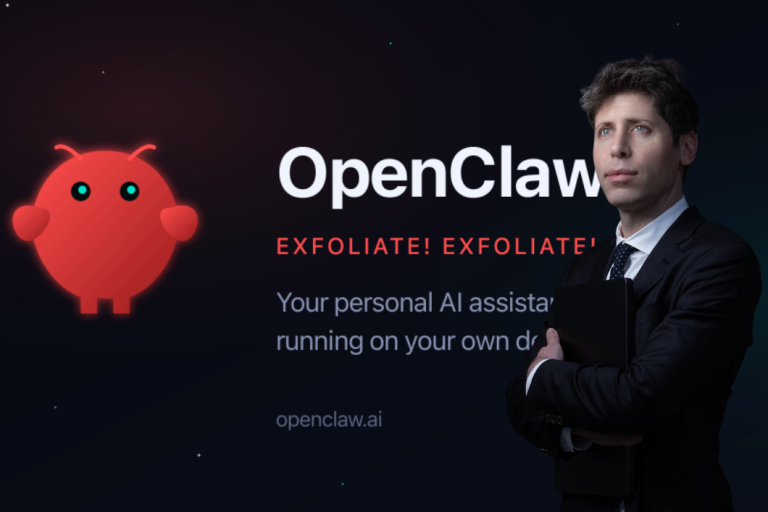
The AI talent war has entered another level.
OpenAI CEO Sam Altman announced that Peter Steinberger, the developer behind the fast-rising autonomous agent OpenClaw, is joining OpenAI. The project itself, Altman said, will continue as an open effort, but now under a foundation supported by the company.
If you’ve watched AI evolve over the past year, you know exactly why this matters.
OpenClaw isn’t just another chatbot.
It’s a glimpse of software that can act.
Peter Steinberger is joining OpenAI to drive the next generation of personal agents. He is a genius with a lot of amazing ideas about the future of very smart agents interacting with each other to do very useful things for people. We expect this will quickly become core to our…
— Sam Altman (@sama) February 15, 2026
From Internet Experiment To Industry Target
Just weeks ago, OpenClaw was an independent release from Steinberger, an Austrian engineer experimenting with how AI systems could move beyond answering questions.
The idea was simple but powerful:
What if AI could operate apps, navigate websites, and complete multi-step tasks with limited supervision?
The internet noticed immediately.
Developers began testing it for workflow automation.
Startups imagined customer service without staff.
Operators saw a future where repetitive digital labor simply disappeared.
Momentum built fast. And in the AI world, speed attracts giants.
Now Steinberger is heading to OpenAI.
Why Everyone Is Racing Toward “Agents”
For two years, generative AI has dazzled people by writing essays, producing images, and generating code.
But companies want something else.
They want AI that can:
-
manage inboxes
-
file reports
-
move information between systems
-
schedule operations
-
make decisions
In other words, they want digital workers.
That’s the promise of agents, and OpenClaw became one of the clearest demonstrations of how near that reality might be.
Altman didn’t hide his excitement. In his announcement, he said Steinberger would help drive the next generation of personal agents, adding that he expects this work to become central to OpenAI’s product lineup.
That is not small talk. That is direction.
Open Source, But With A Gravity Shift
One of the most interesting parts of the deal is that OpenClaw doesn’t disappear.
Instead, it “lives in a foundation” supported by OpenAI.
Practically, that means developers can still experiment and build, but the gravitational center of the project moves toward the most powerful AI company on the planet.
OpenAI gains the builder, the ideas, and influence over how the ecosystem grows.
The community keeps access.
It’s a careful balance between control and credibility.
The Hiring Frenzy Is Getting Expensive
Financial terms weren’t disclosed, but it’s safe to assume the competition for talent is intense.
Across the industry, companies are spending enormous sums to secure the people who might unlock the next breakthrough.
Google continues to expand its AI research footprint.
Meta is building teams at aggressive speed.
Anthropic is gaining enterprise traction with rapid model improvements.
OpenAI, already valued at extraordinary levels, cannot afford to miss a shift as important as agent technology.
If agents become the layer that runs business operations, whoever defines them first shapes how work gets done for a generation.
Not Everyone Is Comfortable With This
OpenClaw’s openness is part of its magic.
It’s also the source of anxiety.
Security researchers worry that powerful, customizable agents could be turned toward automation abuse, fraud, or scalable digital attacks. The more autonomy you grant, the harder oversight becomes.
Bringing Steinberger inside OpenAI may be an attempt to guide the technology’s evolution before it spreads in unpredictable directions.
Innovation, but with a steering wheel.
A Clear Message About The Future
For months, people have asked what comes after chat interfaces.
Altman’s move offers an answer.
The next step is AI that doesn’t just respond — it operates.
It will book, buy, research, coordinate, and execute.
It will move from helper to participant.
OpenClaw hinted at how quickly that transition might happen. Now OpenAI intends to turn that hint into infrastructure.
The Bottom Line
A month ago, OpenClaw was an exciting independent project gaining traction online.
Today, its creator is inside OpenAI, helping shape what the company believes will become a core pillar of its products.
The message to builders everywhere is unmistakable: if you demonstrate the future, the industry will come calling.
And the race to build autonomous digital labor has only just begun.
0 Comments