

A quiet but significant shift in federal policy is rippling through communities across the country after the U.S. Department of State ordered certain public libraries to stop processing passport applications.
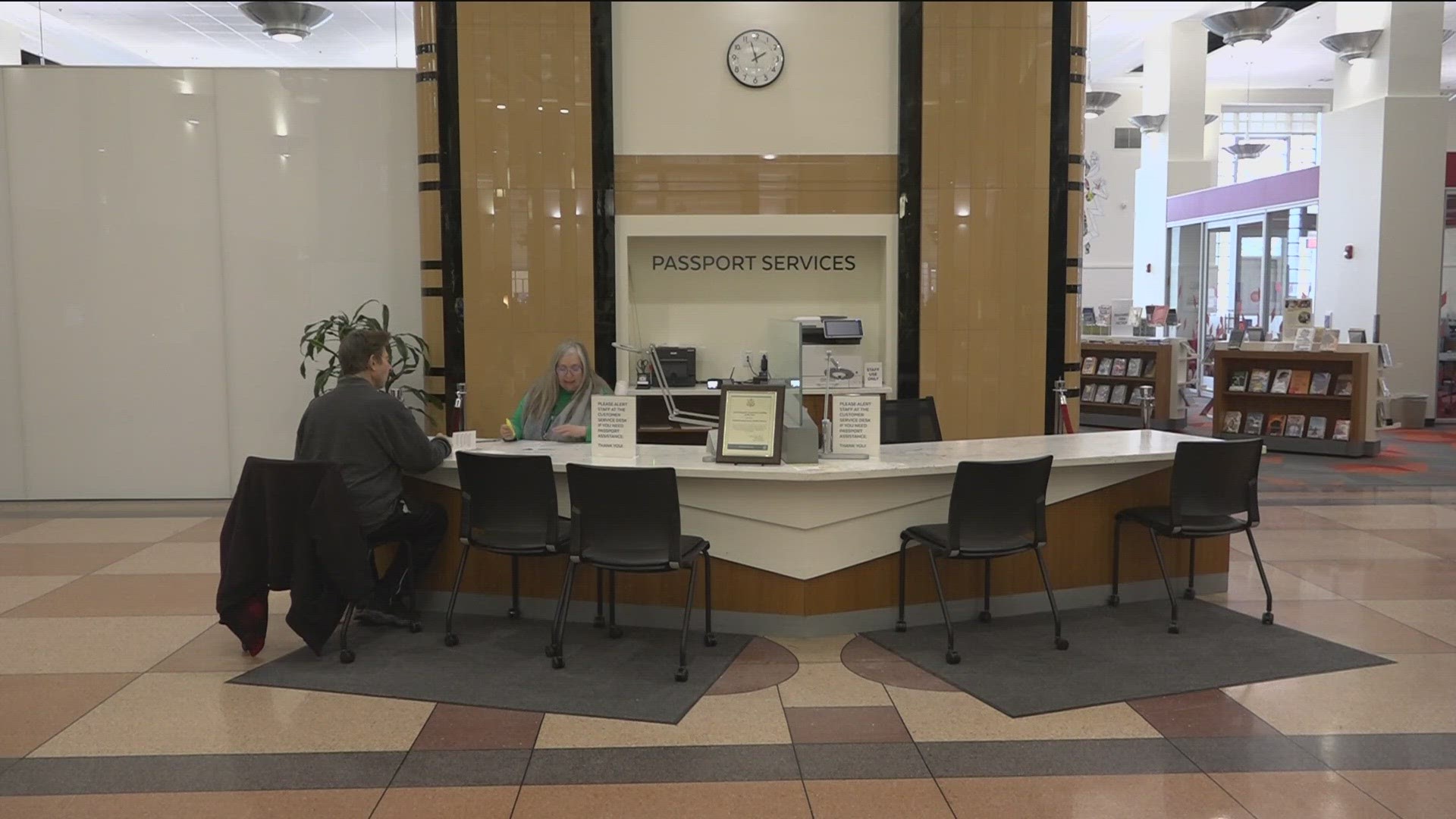
For years, many libraries — particularly those structured as nonprofit organizations — have acted as trusted neighborhood hubs where residents could submit paperwork, verify documents and pay required fees. Now, cease-and-desist letters sent beginning in late fall are ending that arrangement.
The directive says nonprofit entities are no longer authorized to participate in the Passport Acceptance Facility program. Government-run libraries can continue offering the service.
“Our community was so used to us”
At Otis Library in Norwich, passport processing had been available for nearly two decades. Executive director Cathleen Special said the library stopped in November after receiving notice.
Residents, however, have not stopped calling.
“We still get calls daily seeking that service,” she said. “Our community was so used to us offering this.”
Libraries often provided evening and weekend availability, staff who could walk first-time applicants through confusing paperwork, and waiting areas where children could stay occupied. In some towns, librarians also helped residents who faced language barriers or lacked easy transportation.
Why the change?
A State Department spokesperson said federal law and regulations “clearly prohibit non-governmental organizations” from collecting and retaining passport application fees. Because of that interpretation, nonprofit libraries are deemed ineligible.
The agency did not answer why enforcement is intensifying now or how many facilities have already been removed from the program. Officials emphasized that passport acceptance still exists at more than 7,500 sites nationwide and said the affected libraries represent less than one percent of the network.
Library advocates dispute how small the impact really is.
The American Library Association estimates roughly 1,400 mostly nonprofit public libraries could potentially be touched by the decision, depending on how many in each state handle passports.
Bipartisan pushback
Lawmakers from several states are urging Secretary of State Marco Rubio to pause the policy while Congress works on a fix.
In a joint letter, Democrats and Republicans argued that libraries are often the most convenient option for working families and rural residents, particularly as passport demand rises alongside enforcement of Real ID travel requirements.
They warned that removing libraries from the system could force people to drive long distances, miss work or delay travel plans.
Pennsylvania offers one of the clearest examples. In many areas, libraries are organized as nonprofits rather than municipal departments, meaning entire counties could lose convenient access.
Proposed legislation
Representative Madeleine Dean, a Democrat, and Representative John Joyce, a Republican, have introduced bipartisan legislation that would explicitly allow 501(c)(3) nonprofit public libraries to continue serving as passport acceptance facilities by amending the Passport Act of 1920. A companion bill has been introduced in the Senate.
Dean called the State Department’s reading of the law “nonsense,” noting that a library in her district had handled applications smoothly for about 20 years.
In Joyce’s largely rural region, the Marysville-Rye Library had been one of only two locations for passport services across hundreds of square miles. If the rule stands, residents may be left with just a county courthouse.
What happens next?
The State Department maintains that 99% of Americans live within 20 miles of another authorized site, such as a post office or clerk’s office. Officials say they will try to identify new partners where gaps emerge.
But librarians say proximity on a map does not always equal real access.
Post offices often keep limited hours, may lack staff dedicated to helping with complicated cases and can be less accommodating for families with small children. Libraries, by contrast, frequently built their operations around community needs.
Special said her local post office used to refer overflow applicants to the library. Now, she worries, the burden has shifted entirely back.
“I don’t know how they’re keeping up,” she said.
For residents who relied on a familiar face at a neighborhood desk, the change represents more than bureaucratic reshuffling. It is the loss of a service that felt personal, local and dependable.
Whether Congress intervenes — or the policy remains — could determine how easy it will be for many Americans to obtain one of the most important travel documents they own.
0 Comments