

Some managers believe criticism is leadership.
Others treat it like a hobby.
For one employee nearly two decades ago, weekly meetings became less about improving work and more about surviving whatever fault their supervisor decided to find. Commas were wrong. Tone was wrong. Formatting was wrong. Something was always wrong.
And then one day, the employee decided to try something different.
What followed left the boss speechless.
A job that wasn’t what it promised
The worker had recently joined a specialized project team at State Street Bank, lured in by talk of high-visibility assignments and complex financial operations.
The reality?
Instead of strategic problem-solving, the job revolved around compiling data, chasing updates, and producing recurring reports for upper management. People outside the team were nervous to even interact with them, and morale inside the group wasn’t much better.
At the center of it all was the manager — Paula.
According to the employee, Paula had a reputation. No matter how careful someone was, she would find something to criticize. Not the numbers, not the conclusions — the presentation.
A phrase she didn’t like.
A structure she preferred differently.
A formatting tweak that supposedly changed everything.
Week after week, it was the same routine.
The report that could cost millions
One assignment in particular carried real pressure.
The team tracked oil warrants connected to Nigeria — agreements allowing a buyer to purchase oil at a fixed price regardless of market value. With oil fluctuating wildly at the time, the difference between contract price and market price could mean enormous losses.
Accuracy mattered. A lot.
But despite the financial stakes, Paula rarely focused on the numbers. Her frustration almost always landed on wording, layout, or stylistic choices.
After enough cycles of this, the employee began job hunting. But before leaving, an opportunity for a little experiment appeared.
A discovery on the shared drive
While digging through old network folders, the employee found something unexpected: reports from years earlier, created back when Paula herself did the job.
Templates.
Cover letters.
Language.
All of it.
A thought formed: What would happen if I used her exact approach?
So the employee rebuilt the next report in Paula’s image. Same structure. Same tone. Nearly identical phrasing. Only the data changed.
Then they walked it into her office for approval.
The explosion
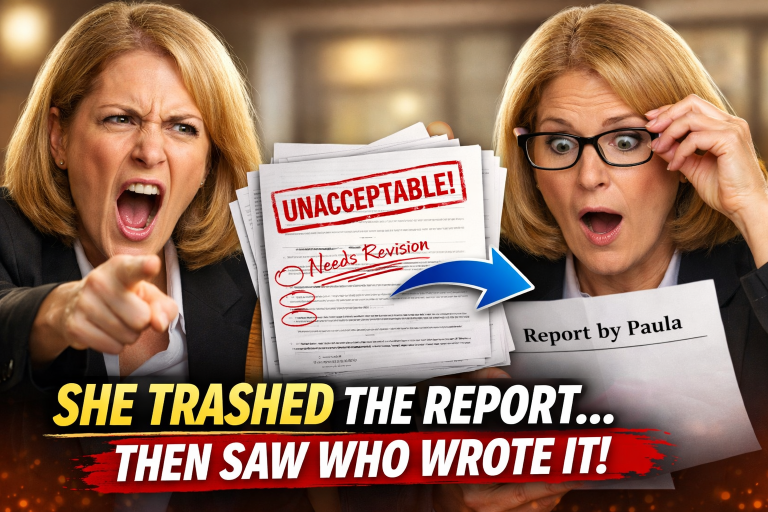
Paula took one look and erupted.
What happened to the previous format?
Why would you change it?
This might be the worst version yet.
On and on she went, listing flaw after flaw. The employee stayed quiet, letting the storm pass.
Finally, she asked the question: What were you thinking?
The answer landed like a dropped glass.
“I used your reports,” the employee said. “From the old project. I found them on the drive and followed them exactly.”
And just to make sure the point couldn’t be missed, they placed printouts of Paula’s originals side by side with the new version.
Silence
The anger drained out of the room.
Paula stared at the pages, stunned. A moment earlier the document had been “terrible” and “unreadable.” Now it was unmistakably her own work.
The employee gently twisted the knife.
“So… should I go back to my format?”
Paula signed the report.
Send it as is.
No time to redo anything.
The game continues
From that day forward, the worker kept copies of Paula’s historical templates. Whenever criticism started, they would rely on her own past language.
Eventually she realized what was happening. When she asked, the employee calmly explained they had built standard procedures based on her earlier material. It seemed logical, after all.
Not long after, the employee found a new job and left.
But the memory of that stunned expression?
Still priceless.
Below is the original Reddit post that inspired the story.
Boss always found an error with my monthly reports and cover letters, so I used her old ones and watched her rip them apart.
by u/MerryMisandrist in pettyrevenge
0 Comments